Bobby Kim Ling Chen

1. BIOGRAPHY
Operating as an "end-to-end" independent digital creator, Bobby Kim Ling Chen specializes in digital image derivatives and interactive media interfaces. Rejecting the corporate, team-driven structures of high-budget digital production, he leverages consumer-grade hardware paired with complex programming to single-handedly construct multi-layered artistic ecosystems.
His practice rests on a foundational philosophy that a "truly digital art" is one that actively collapses the wall between the canvas and the spectator.
By integrating tools like marker-less web-based Augmented Reality (AR), HTML5 execution, his work extends the structural boundaries of the canvas onto personal digital devices. This methodology provokes a permanent paradigm shift in how fine art is consumed and valued. His interactive installations purposefully weaponize elements of light contrast, three-dimensional depth, and optical illusions to demand somatic engagement. Ultimately, his work redefines the viewer from a detached observer into an active, vital component of the artwork's final completion.
Representative Accomplishments
*Printed Publication—"A like Artist" (2022) exhibited in ArtsLibris, ARCOmadrid
ARCOLisboa (2023)
*Certificates of Artistic Achievement (2022-2025) from The Pinacothèque Museum’s Luxembourg Art Prize
*Juried Fine Art Awards
Camelback Gallery
ArtAscent (2024)
*Exhibitions/Finalist
International Digital Art Contest 2026 -
Academy of Fine Arts, University of Mostar
HMVC Gallery New York
Las Laguna Gallery
Teravarna
Artmajeur
Loupe Art
Transhuman Italy
Chengdu International Art Spaces
2. THE WORK
A digital derivative artwork processed with multiple online software and Microsoft Powerpoint and embedded QR that leads the spectator to an INTERACTIVE GAME. Dimension: 3520x6259 pixels. Check it out at https://game.trulydigital.art/
3. THE STORY
Check out on "How The Artwork Is Produce" here: https://art18.trulydgtal.com/video.html
As mentioned in the Bio, I am a digital artist specialised in artwork that takes the viewer from the canvas into another world "associated" with arts using a QR. For examples, the QR may lead to:
another still image or motion artwork, an algorithm that performs random calculations in presenting the artwork, an Augmented Reality (AR) presentation or WebAR activity, experimental art or downloadable artwork, multi-platform disseminations, or an algorithm that interact with the viewer or process a game that is related to the artwork. This art piece is my first and most elaborated interactive artwork that processes a game which "prophecies" on the spectator selecting a flower token related to the artwork.
The backbone technique used in this digital art is "derivative art". No AI is involved in the artwork creation. As limited as the resources are (i.e. data assets and elements such as raw photos, image, footage, etc.), all elements are public domain if not self-owned assets, and "processed" before they are used in the artworks.
The lack of resources perhaps alway pushes me to face the challenges and thus making digital derivative art my favorite techniques over digital painting and generative art.
In addition to the lack of resources and contrary to the belief that derivative arts are easy, the process could be bumpy as the number of transformations of the raw data assets could be high if the objects chosen are far from what the final elements should look like. When each elements completed the processing, they are placed on a “canvas”, normally a software such as Microsoft PowerPoint, Photoshop, to create the final artwork. Again, if they failed to reach the intended goal at this stage, and much like in traditional painting where touch-ups are necessary, these elements may have to be reprocessed (touch-up). But unlike traditional painting that only touch-ups are needed, data assets and elements may have to be reselected altogether and processed from the very beginning should they be "stubborn" and refused to reach what the heart desire for a finished piece.
Exemplary Derivative Arts
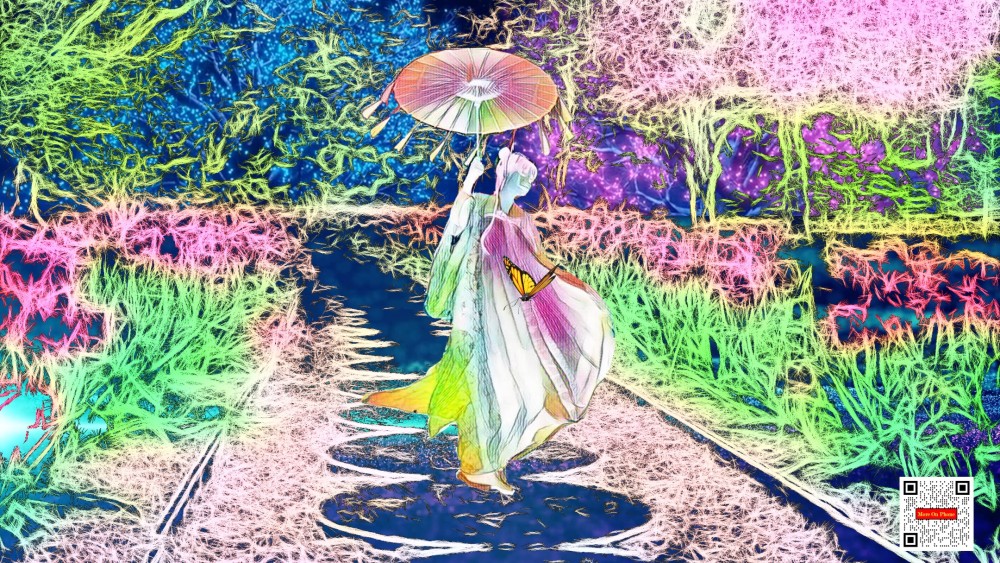
The Fairy In Alt Universe
If you think this is a beautiful digital artwork, wait till you scan the QR and see the beauty extended on to your phone in motion.

Robots At Odds
This is a simple derivative art abstract. Although no QR code is involved in this one, it is still interactive by means of optical...